
Custom Baby Bodysuits: What the Spec Sheet Must Cover
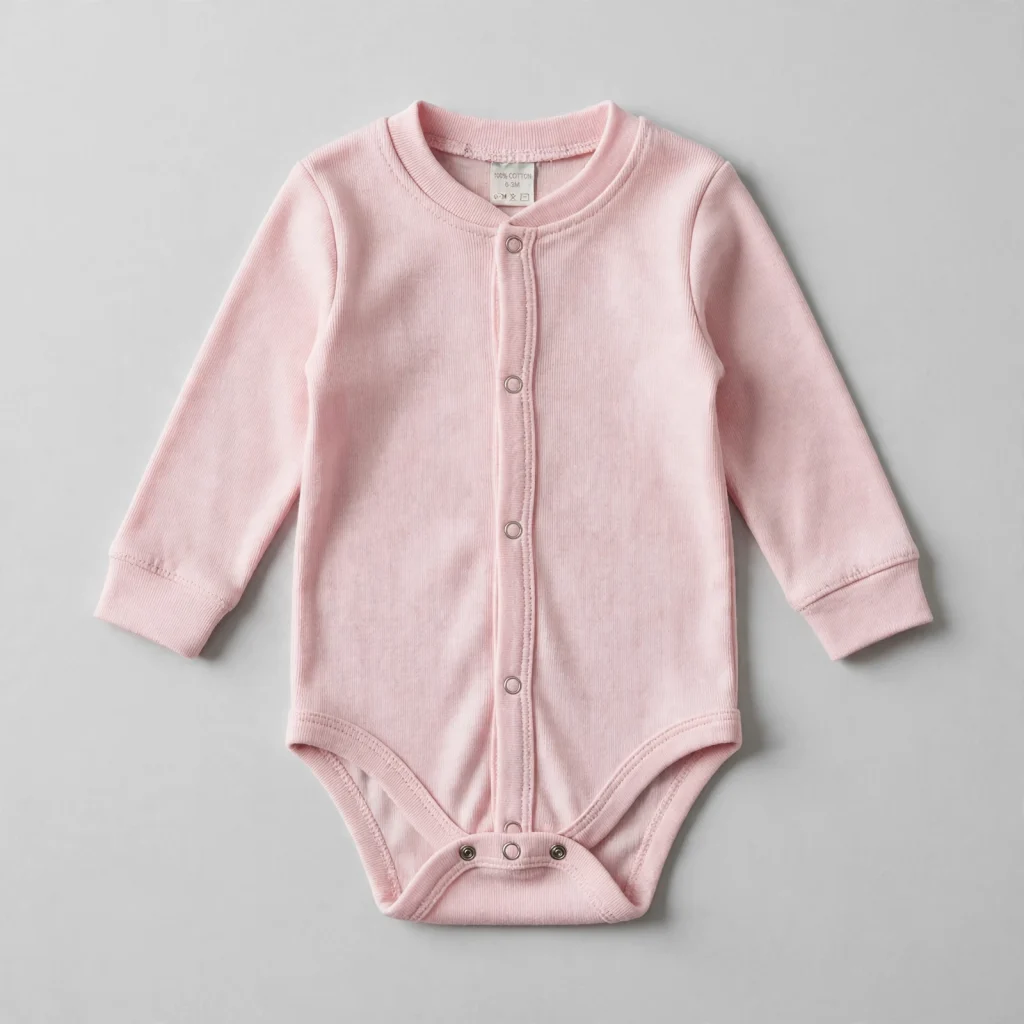
Custom baby bodysuits look simple on a hanger. In practice, they are the hardest infant garment to get right. Parents use them every day, wash them constantly, and judge a brand by how the snaps, seams and fabric hold up. A clear spec sheet protects both sides. The brand gets the garment it approved, and the factory builds the same garment in every size, in every carton, and on every reorder.
This guide walks through the checks USA and UK brands run before they order. It covers fabric and GSM, snap testing, grading and labelling. It is written from the factory floor, so each point names the detail that actually decides quality, not the sales line.
Seven Checks Before You Order Custom Baby Bodysuits
Before any fabric is cut, run through these seven checks with your supplier. They take one call to confirm.
- Fabric and GSM matched to the season, the price point and the wash load
- Nickel-free snaps, set after sewing on reinforced plackets and pull-tested on every batch
- An envelope neckline that stretches wide, then springs back to shape
- Flat seams and bound leg openings that sit soft on skin and leave no red marks
- Grading that grows in length first, with snap positions fixed across sizes
- Prints and labels that survive wash testing and meet USA and UK rules
- A sample set approved in the real fabrics before bulk cutting starts
If a supplier cannot answer one of these points in writing, treat that as a gap.
Fabric and GSM: Matching Cloth to the Baby
For custom baby bodysuits, fabric choice decides how the garment washes, stretches and feels after twenty washes. Four cloths cover most programmes, and each one suits a different price point and season.
- Combed cotton jersey, 160 to 180 GSM. Soft, breathable and light in stretch. This is the everyday bodysuit cloth, and the right pick for multipacks and newborn ranges.
- Cotton interlock, 180 to 200 GSM. Smooth on both sides, with a firm hand that holds shape. This suits premium ranges and printed styles that need a flat, stable face.
- Cotton with elastane rib, 200 to 220 GSM. Firm stretch and a close fit. This works for sleep and layering bodysuits, where the garment must stay close without binding.
- Organic cotton jersey. Soft, undyed or low-impact dyed. This is the pick for eco-positioned infant brands, and it pairs well with water-based prints.
GSM is a guide, not a guarantee. A 170 GSM jersey from combed yarn feels softer than a 200 GSM cloth from coarse yarn. So ask for the yarn count and the finish as well as the weight. Ask how the fabric is rested before cutting. Jersey cut from unrelaxed cloth twists after the first wash.
Print choice belongs in the same decision. Water-based prints stay soft against skin, so they are the usual pick for newborn ranges. Plastisol gives brighter fashion colours on older baby sizes, but it must be phthalate-free. All four cloths run in our baby bodysuits programme, so you can mix everyday and premium styles in one order.
Snaps, Necklines and Seams: The Parts Parents Touch Every Day
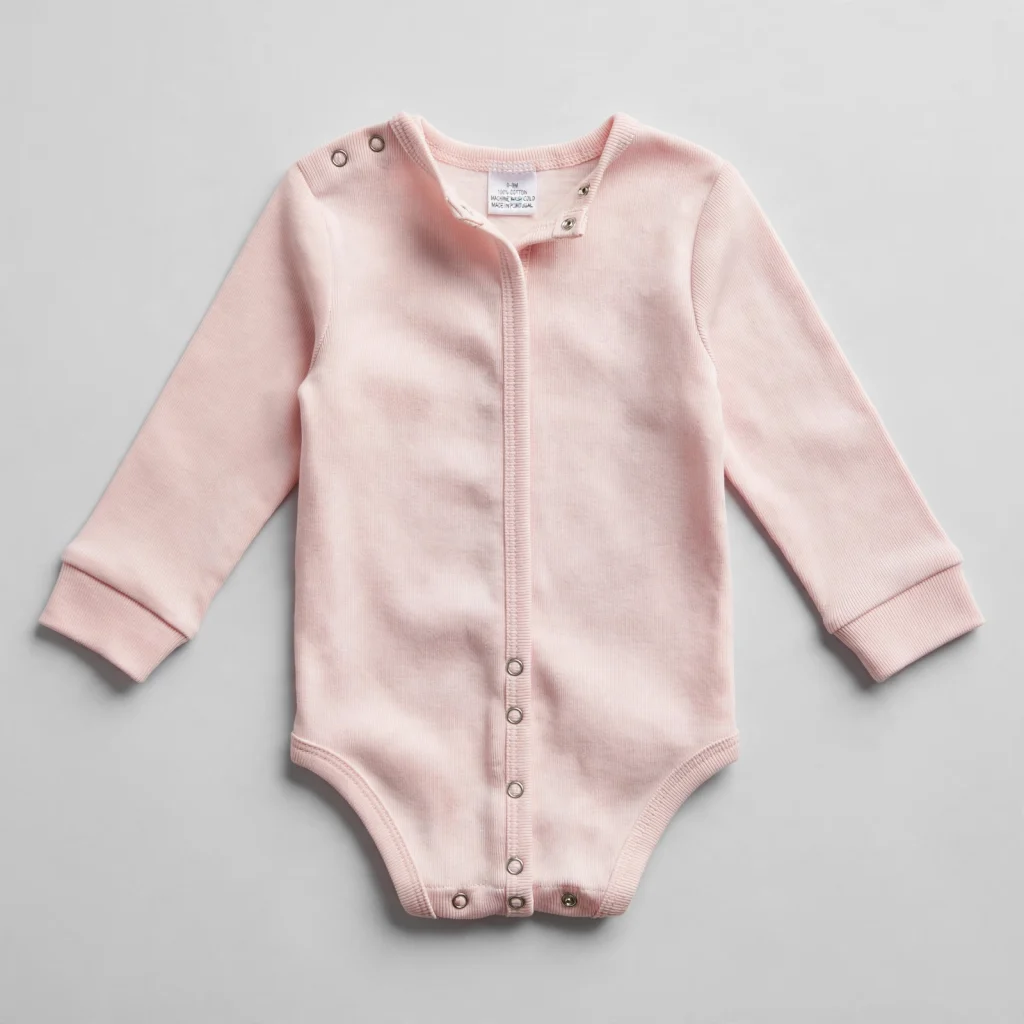
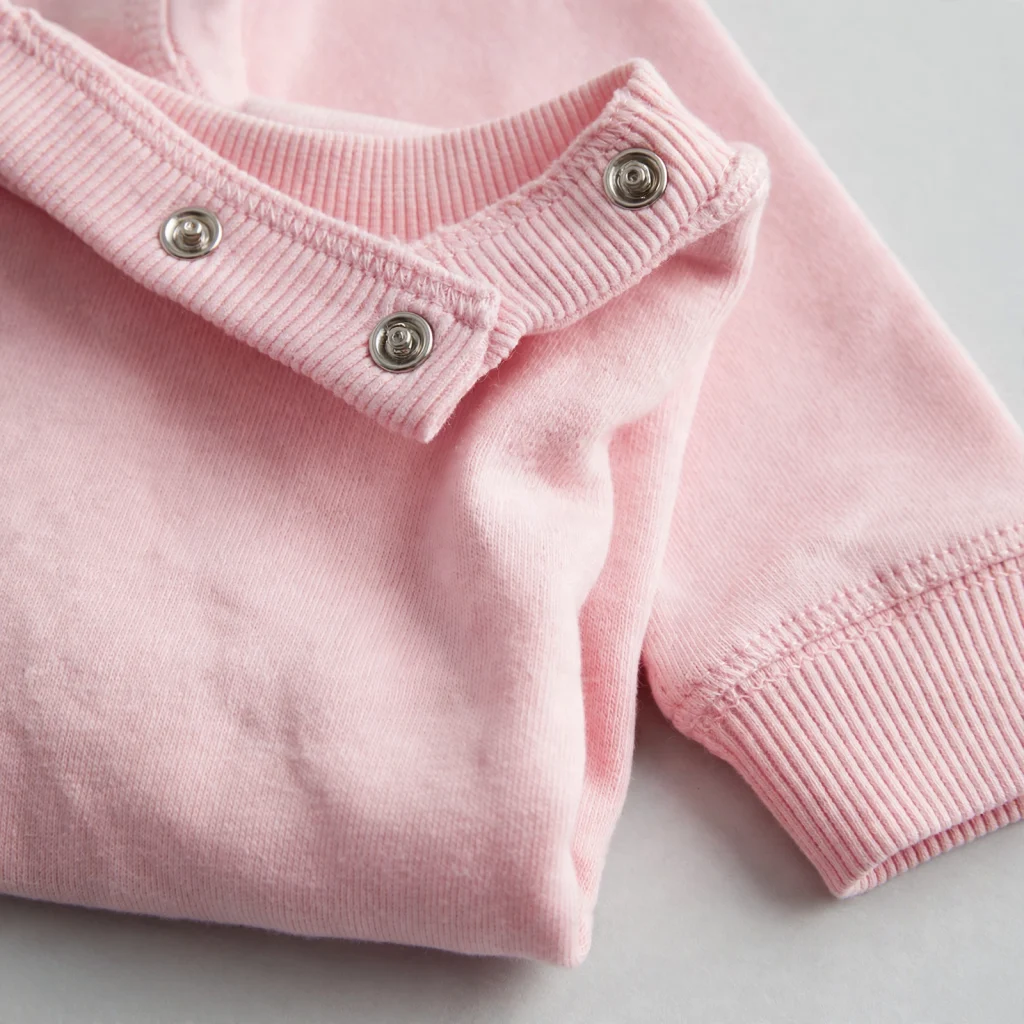
When you order, ask how the snaps are set. The crotch closure takes more work than any other part of the garment. We fit nickel-free press snaps as standard. They sit on reinforced plackets, so repeated opening does not tear the fabric. Snaps are set after sewing, not before, so placement lands exactly on the placket. Each snap is pressed, checked by hand and pull-tested on a sample from every batch.
Snap type matters as much as snap strength. Prong snaps suit babywear and stretch knits. Their open ring grips light fabric without cutting yarns. Heavy ring-spring snaps belong on coats and denim, not on a 170 GSM jersey. Their high unfastening force will in time rip the snap straight through the cloth. If a supplier offers one snap type for every garment, ask what it uses on its lightest jersey. Then ask for the pull test result in writing.
Neckline Styles for the Smallest Sizes
The neckline decides whether dressing is easy or a struggle. The classic envelope neckline stretches wide. It slips over a baby’s head, or down over the body after a leak, without forcing. Lap shoulder, kimono wrap and side snap styles suit the smallest sizes. A wrap front avoids anything passing over the head at all. Each style is graded as one family, so newborn, 0 to 3 month and 3 to 6 month sizes all dress the same way.
Seams deserve the same attention. Shoulder seams should sit flat and soft, because they sit directly on newborn skin. Inside seams are finished flat. Leg openings are bound with soft elastic that leaves no red marks. Printed neck labels replace sewn tags, so nothing scratches the neck. A good check is simple: turn the sample inside out, run a finger along every seam, and look for loose threads.
For the testing rules behind these checks, see the button and snap pull test standards for USA and UK kidswear. They explain the pull forces and the audit points a buyer should ask for.
Sizing and Grading: USA and UK Size Systems
Grading custom baby bodysuits starts with length. Babies outgrow length before width, so a careful factory grades body length generously. It also keeps snap positions consistent across sizes, so parents meet the same garment at every age.
The two markets size in different ways, so confirm which system your order follows.
- USA sizes run in months: newborn, 0 to 3, 3 to 6, 6 to 9, 9 to 12, 12 to 18 and 18 to 24 months. US buyers work from a measurement chart in inches, and they check length first on the sample.
- UK sizes also run in months, but UK buyers often ask for centimetre measurements on the chart as well. They check the garment against high street size forms.
- Shared rule for both markets: grade to the buyer’s own measurement chart when one exists. Measure a sample from every size against the agreed chart at final audit. One size checked is not a range checked.
Fit-Checking on Real Forms
Fit checking needs a real form, not a flat table. Ask for fit photos on a size form in your smallest and largest sizes. Also ask how much the body length grows between steps.
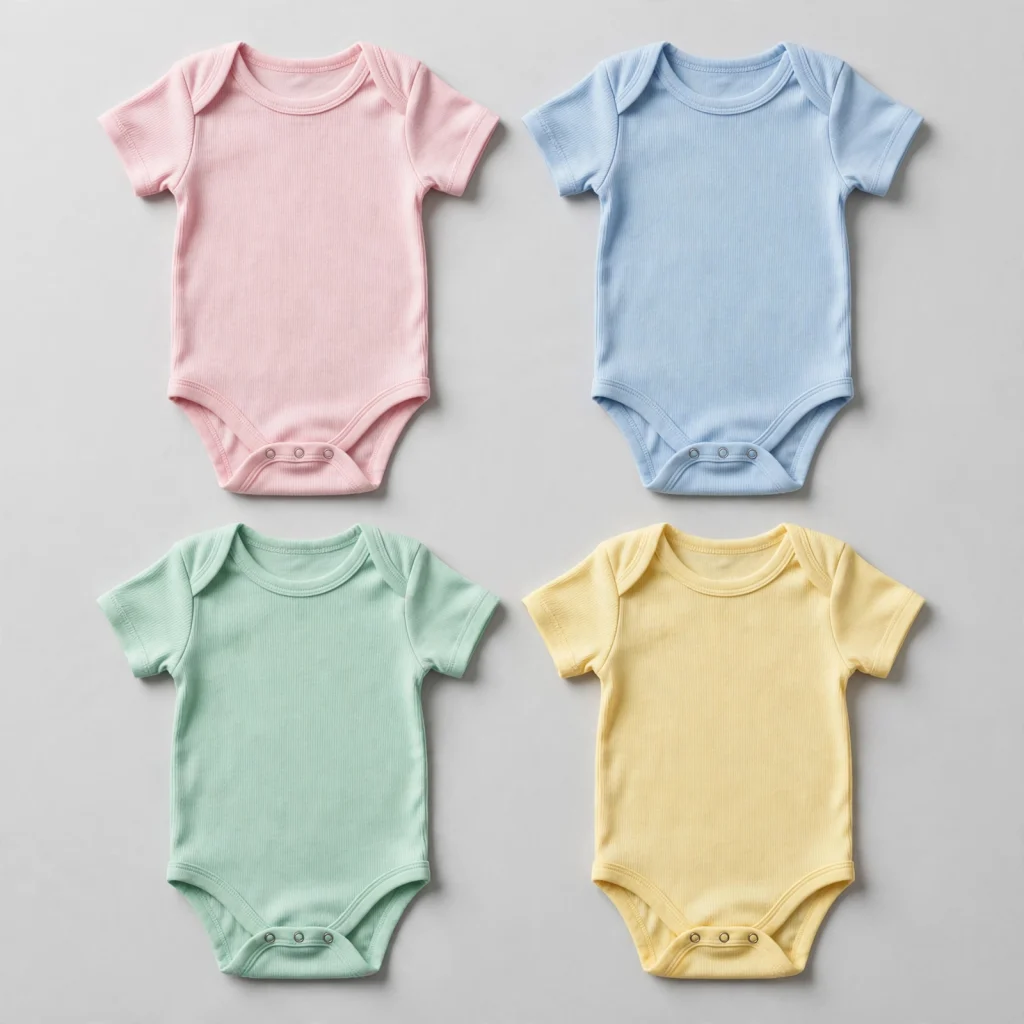
Many buyers run bodysuits together with rompers and tees from the same brand, so colours and prints match across the whole infant set. Shared fabrics and print screens keep colours consistent. That is why the range is usually planned as one programme, not as three separate orders. Our baby bodysuits made to your size chart are graded as one family for exactly this reason. A bodysuit, a romper and a tee in the same print then read as one collection.
Labels and Compliance: USA and UK Rules in Practice
Labels are where USA and UK orders differ most. Build them into the order from the start, not as an afterthought at packing. The two markets ask for different things.
- USA: buyers specify tracking labels under their own CPSIA compliance work. They need fibre content, country of origin and care instructions in the form their retailers accept. Third-party testing at a CPSC-accepted lab is part of the process for infant wear.
- UK: buyers focus on fibre content and care labelling, with wash symbols and fibre names in the form UK retailers expect. Labels must read clearly after washing, so print durability is tested with the garment, not separately.
- Both markets: OEKO-TEX Standard 100, Product Class I, is the fabric benchmark most infant brands ask for. It sets the strictest limits for articles that touch baby skin. For wider industry background, OEKO-TEX publishes useful guidance on fabric safety and chemical standards for baby articles.
Test the Printed Piece, Not Only the Cloth
Flammability, lead and phthalate limits sit behind these label rules. They are checked on the finished garment, not on the fabric alone. A print can fail a test that the base cloth passes. So ask for test results on printed pieces, not only on blank fabric.
For a sense of how the same safety thinking runs across the infant range, our baby tees buying guide for USA and Canada brands covers the fabric and compliance checks that sister styles share with bodysuits.
Ordering Steps: From Sample Set to Bulk
Most custom baby bodysuits programmes start with a sample set, and that is the normal first step. A sample set in your fabrics and prints lets you wash-test, fit-check on your own size forms, and approve every detail before committing to a production run. Never skip it to save a week. A bulk fault costs far more than a sample delay.
Production runs in a set order. Fabric is rested and checked for shading and shrinkage before cutting. Panels are cut in small lays, so shade stays consistent inside each size. Necklines and leg openings are bound before the side seams close. Binding is where cheap bodysuits fail first. Our operators sew it in a single pass with matched tension, and the binding fabric is cut from the same dyed lot as the body.
What the Final Audit Covers
Quality checks run inline, not only at the end. Inline checks cover seam strength, snap function and print registration. The final audit measures a sample from every size against the agreed chart. It washes test pieces to confirm shrinkage stays inside the tolerance you approved. If you work with an independent inspection company, the factory should schedule the inspection before dispatch and hold cartons until the report clears.
Packing closes the order: single pieces, folded multipacks or gift sets, packed to your instruction. Your labels, hangtags and barcodes go on before cartons are sealed. Ask for a packing photo of the first sealed carton.
Key Takeaways Before You Order
In short, a good bodysuit order is decided on paper before it is decided on the sewing floor.
- Match fabric and GSM to the season and the wash load, and ask for yarn count as well as weight
- Specify nickel-free snaps, set after sewing, with a pull test on every batch
- Grade length first, keep snap positions fixed, and fit-check the smallest and largest sizes
- Build USA and UK labels into the order, and test printed pieces, not only blank fabric
- Approve a sample set in the real fabrics before bulk cutting starts
If you are building an infant range, send us your designs, fabric preferences and size plan. As your manufacturer, we will return a sample path and a production plan built around your label. See our custom baby bodysuits programme to start the conversation.